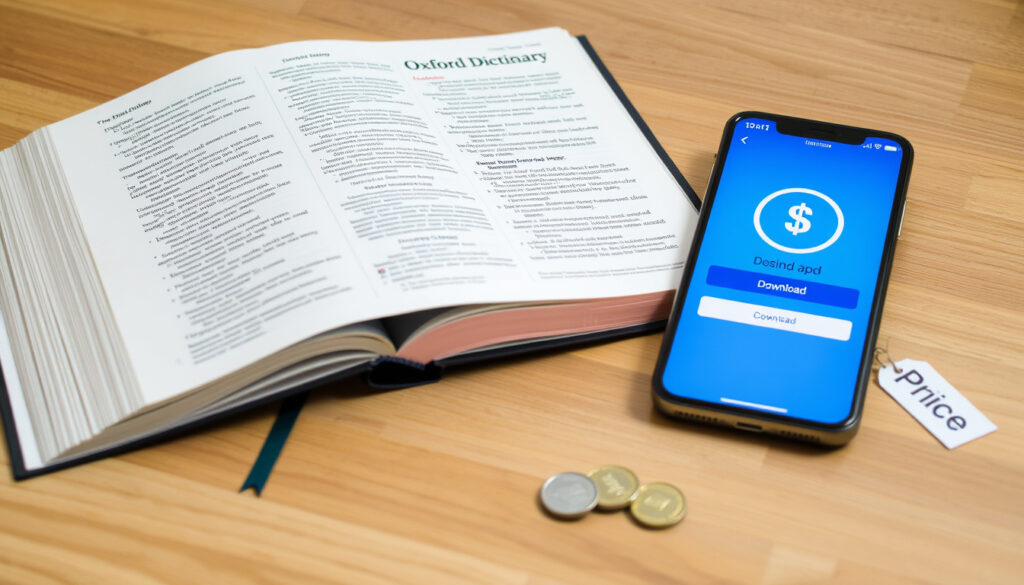
Oxford Dictionary – Free Access, App Downloads, and Costs
When people search for the “Oxford Dictionary,” they often expect a single product. In reality, the name covers several distinct tools: the free Oxford Learner’s Dictionaries website, the subscription-based Oxford English Dictionary (OED), mobile apps with varying paywalls, and printed reference books. Understanding which version meets your needs—and at what cost—requires separating these offerings.
The confusion is understandable. The Oxford brand is synonymous with English language authority. But the free online resource that many users find first is actually Oxford Learner’s Dictionaries, while the historic OED behind its academic reputation requires a paid subscription. This article breaks down the costs, download options, and best use cases for each platform in 2025.
Is the Oxford Dictionary Free or Paid? (Breaking Down the Cost)
| Platform | Cost | Best For | Offline Access |
|---|---|---|---|
| Online (Learner’s) | Free | ESL Learners | No |
| Online (OED) | Subscription (~£75/yr) | Academics/Historians | No |
| App (Mobile) | Free/$5-$30 in-app | On-the-go reference | Yes (partial) |
| Print Book | £20 – £100+ | Classic reference | Yes (physical) |
Key Insights
- The Oxford Dictionary brand actually covers two distinct products: the free Oxford Learner’s Dictionaries (for ESL) and the subscription-based Oxford English Dictionary (OED) (for comprehensive historical research).
- Most users searching ‘Oxford Dictionary online free’ actually want the Learner’s version, which is completely free, not the OED.
- The official Oxford Dictionary app offers offline access to select dictionaries, but full OED access requires a subscription even on mobile.
- Unauthorized PDF versions of the OED are widely available but violate copyright and are usually incomplete or outdated.
- The OED is updated quarterly, making a digital subscription more current than any print edition after its release year.
| Fact | Value |
|---|---|
| Total words (OED) | Over 500,000 entries |
| First Published | 1884 (first fascicle) |
| Current Edition (OED) | 3rd Edition (online, continuously updated) |
| Free Version | Oxford Learner’s Dictionaries (oxfordlearnersdictionaries.com) |
| Official Publisher | Oxford University Press (OUP) |
| App Rating (Google Play) | 4.4 / 5 (based on recent reviews) |
How to Access the Oxford Dictionary: App, Online, and Download Guide
Step-by-Step: Downloading the Official Oxford Dictionary App (Android/iOS)
The Oxford Dictionary & Thesaurus app on Google Play is free to download but displays ads. A premium subscription removes ads, enables offline mode, adds audio pronunciation, and unlocks unlimited synonym lookups. The same app on the App Store is listed as Free with in-app purchases for monthly or annual subscriptions. For learners, the Oxford Advanced Learner’s Dictionary app offers sample content for free and a trial period before requiring payment for full access.
Using the Online Version: Browser Access Tips
The Oxford Learner’s Dictionaries website is completely free. It includes definitions, example sentences, synonyms, and audio pronunciations for British and American English. No account is needed. The OED online, available at oed.com, requires an individual or institutional subscription.
Offline Mode: Saving Words and Dictionaries for Travel
Only the premium version of the Oxford Dictionary & Thesaurus app allows offline use. The free learner’s dictionaries website does not offer offline access. The OED online cannot be downloaded in full for offline reading.
The premium Oxford Dictionary & Thesaurus app (about $5–$30 in in-app purchases) lets you download dictionaries for offline lookup. The OED and learner’s sites require an internet connection.
Which Oxford Dictionary Should You Choose? (OED vs Learner’s vs Pocket)
The Oxford English Dictionary (OED): The Historian’s Choice
The Oxford English Dictionary (OED) is the definitive historical record of the English language. It traces word usage over more than 1,000 years through quotations. With over 500,000 entries, it is best suited for linguists, historians, and serious researchers. Access is via paid subscription only.
Oxford Advanced Learner’s Dictionary (OALD): Best for Students
The Oxford Advanced Learner’s Dictionary is designed for non-native speakers. It offers simplified definitions, example sentences, collocations, and pronunciation guides. The app provides a free trial; full access can be purchased individually or as part of a bundle.
Oxford Dictionary of English (ODE): The Standard Reference
The Oxford Dictionary of English (ODE) is a single-volume dictionary focusing on current English usage. It contains over 350,000 entries and is available in print, as an app, and as part of some online subscriptions. It is a middle ground between the learner’s dictionary and the OED.
Why Cambridge vs Oxford Matters for Your Learning Style
Cambridge Dictionary offers free online access with British and American English definitions, often with more example sentences. Oxford Learner’s Dictionaries is also free but emphasizes collocations and thesaurus entries. For advanced students, the choice often comes down to which interface and example style feels more natural. Oxford Learner’s Dictionaries remains the leading free learner resource from Oxford University Press.
If you are an English learner looking for a free online tool, start with Oxford Learner’s Dictionaries. If you need a scholarly dictionary for research, the OED subscription is the only option. For everyday offline reference on a phone, the premium Oxford Dictionary app is the best bet.
Can You Get the Oxford Dictionary as a PDF? (Legitimacy & Options)
Official PDF Versions vs Unauthorized Downloads
Oxford University Press does not sell or distribute the full OED or any official Oxford Dictionary as a free PDF. Unauthorized copies found online infringe copyright and often contain outdated or incomplete content. The only legitimate way to access the complete OED digitally is through the online subscription platform at oed.com.
The Oxford Dictionary Book: Print Editions and Pricing
Print editions of the Oxford Dictionary of English and the Oxford Advanced Learner’s Dictionary are available from bookstores and the Oxford University Press website. Prices range from £20 for a compact edition to over £100 for multi-volume sets. The full OED in print was last issued as the second edition (20 volumes) in 1989; no new print edition is planned.
Best Sources for Digital Copies (Google Books, OUP Store)
Some Oxford dictionaries are available as eBooks through retailers like Amazon and Google Books. However, these are typically the learner’s or concise editions, not the OED. For institutional access, libraries often subscribe to the OED online, providing patrons with free access.
Free PDF downloads claiming to be the Oxford English Dictionary are almost always illegal and may contain malware or outdated content. Only use official channels: the OED online subscription, authorized apps, and print editions from Oxford University Press.
What Is the History of the Oxford English Dictionary?
The Oxford English Dictionary began in 1857 when the Philological Society of London proposed a new English dictionary that would record every word from the early Middle English period onward. The first volume (A–Ant) appeared in 1884, and the full first edition was completed in 1928 across 10 volumes. A 12-volume reprint with supplement followed in 1933. The second edition arrived in 1989 in 20 volumes. In 2000, the OED Online made the entire dictionary accessible via the internet. The first mobile app was released in 2014. As of 2025, the OED is continuously updated with quarterly revisions.
- – Philological Society proposes a new English Dictionary.
- – First volume (A–Ant) published.
- – First edition complete (10 volumes).
- – Reprinted as 12-volume set with supplement.
- – Second edition (20 volumes) published.
- – OED Online launched.
- – First mobile app version released.
- – Continuous digital updates; quarterly revisions online.
What We Know and What Remains Unclear About the Oxford Dictionary
| Established Information | Information That Remains Unclear |
|---|---|
| The OED is the definitive historical record of the English language. | Pricing for individual OED subscriptions may change based on promotional offers or regional discounts. |
| Oxford Learner’s Dictionaries is a completely free website and app (with optional premium features). | The exact number of words in the OED is constantly growing; figures like ‘500,000’ are approximations. |
| The OED online requires a subscription (individual or institutional). | The future of the print edition is uncertain; OUP has signaled a digital-first strategy. |
| PDF copies of the full OED are not sold by OUP; only the digital platform is offered for the complete dictionary. |
Why the Oxford Dictionary Remains the Gold Standard (2025 Analysis)
The OED’s historical quotations trace word usage back over 1,000 years, an unmatched resource for linguists and historians. The free Learner’s Dictionary fills a critical gap for non-native speakers, offering simplified definitions, example sentences, and pronunciation guides. Competitors like Cambridge and Merriam-Webster offer free content, but Oxford’s brand authority and academic lineage provide a unique trust signal. For users, understanding the ‘free vs paid’ distinction solves the most common confusion immediately.
Sources and Statements About the Oxford Dictionary
An unsurpassed guide for researchers in any discipline to the meaning, history, and usage of over 500,000 words.
OED Official Website (oed.com)
The largest and most trusted free online dictionary for learners of British and American English.
Oxford Learner’s Dictionaries (oxfordlearnersdictionaries.com)
The Oxford English Dictionary (OED) is the principal historical dictionary of the English language.
Wikipedia – Oxford English Dictionary
The Oxford Dictionary in 2025: What You Need to Know
Choosing the right Oxford Dictionary depends on your purpose. For learners, the free Oxford Learner’s Dictionaries online is the best starting point. For academic research, the OED subscription remains irreplaceable. For mobile offline use, the premium Oxford Dictionary app offers the most complete package. Print editions still exist for traditionalists, but digital access—via web or app—is the most current and practical option.
Frequently Asked Questions
What is the difference between the Oxford Dictionary and the Oxford English Dictionary?
The ‘Oxford Dictionary’ typically refers to the Oxford Dictionary of English (ODE) or Oxford Learner’s Dictionaries, which focus on current usage. The Oxford English Dictionary (OED) is a historical dictionary tracing word origins and changes over time.
Is the Oxford Dictionary app free?
The app itself is often free to download, but full access to content like the OED usually requires a subscription. Some free dictionaries (like the Learner’s) are included without extra charge.
How many words are in the Oxford Dictionary?
The OED contains over 500,000 entries. The Oxford Dictionary of English contains over 350,000 entries. The Learner’s Dictionary has approximately 180,000 entries.
Can I get the Oxford Dictionary on my Kindle or e-reader?
Yes, some Oxford dictionaries are available as eBooks for Kindle and other e-readers via Amazon or OUP. However, the full OED is not available as an eBook due to its size and complexity.
Who wrote the Oxford Dictionary?
The OED was originally compiled by the Philological Society of London, led by James Murray. Today, it is maintained by a team of lexicographers at Oxford University Press.
More related posts
 Mystic Meg Daily Horoscopes – Archives Access Guide
 Sunday Time Be t Seller – Current Li t, Hi tory & Complete Guide
 How to Cook Gammon – Times, Methods and Glazing Guide
 Jaden Philogene – Age, Stats, Injury and Career Update
 Olivia Attwood Net Worth – 2025/2026 Estimates and Rankings
 Calories in a Pint of Guinness – Nutrition Facts UK and US Sizes
 Bt Email Sign In – Complete Guide and Fixes
 Average Height for Women – UK US Europe Worldwide Stats